The Ancient Rivers of Ice that Shape the Last Frontier
There are a few places on earth where you can stand in complete silence and hear the earth moving.
In Alaska, glaciers are not just scenery. They are living, moving forces of nature that have carved mountains, shaped coastlines, created fjords, and transformed the landscape for millions of years. They are enormous, ancient, beautiful, and surprisingly alive.
For many travelers, seeing a glacier becomes the emotional highlight of an Alaska trip. Pictures never prepare you for the sheer scale. You may be a mile away and still feel close enough to touch it. The color, the sound, the size, and the raw power are overwhelming in the best possible way.
Whether you're planning an Alaska cruise or a land journey, understanding glaciers makes seeing them even more incredible.
What exactly is a glacier?
A glacier is essentially a massive river of ice that forms slowly over time from layers of compressed snow.
But unlike the ice cubes in the freezer, glacial ice is ancient. Some of Alaska's glaciers contain snow that fell hundreds or even thousands of years ago.
Glaciers form in places where more snow falls in winter than melts during summer. Over time, the weight of new snowfall compresses the older snow underneath it.
- Snowfall accumulates.
Fresh snow falls year after year in high mountain regions where temperatures remain cold enough for snow to survive through summer.
2. Snow Compresses into Firn.
As layers build up, the snow beneath becomes denser and grainier. This partially compressed snow is called firn.
3. Firn Becomes Glacial Ice.
Over decades or centuries, pressure squeezes out air pockets. The ice crystals become tightly packed into dense glacier ice.
4. Gravity Makes the Glacier Move.
Once the ice mass becomes heavy enough, gravity slowly pulls it downhill. That movement is what makes a glacier a glacier. Some glaciers move only inches per year. Others can move several feet per day.
Why are Glaciers Blue?
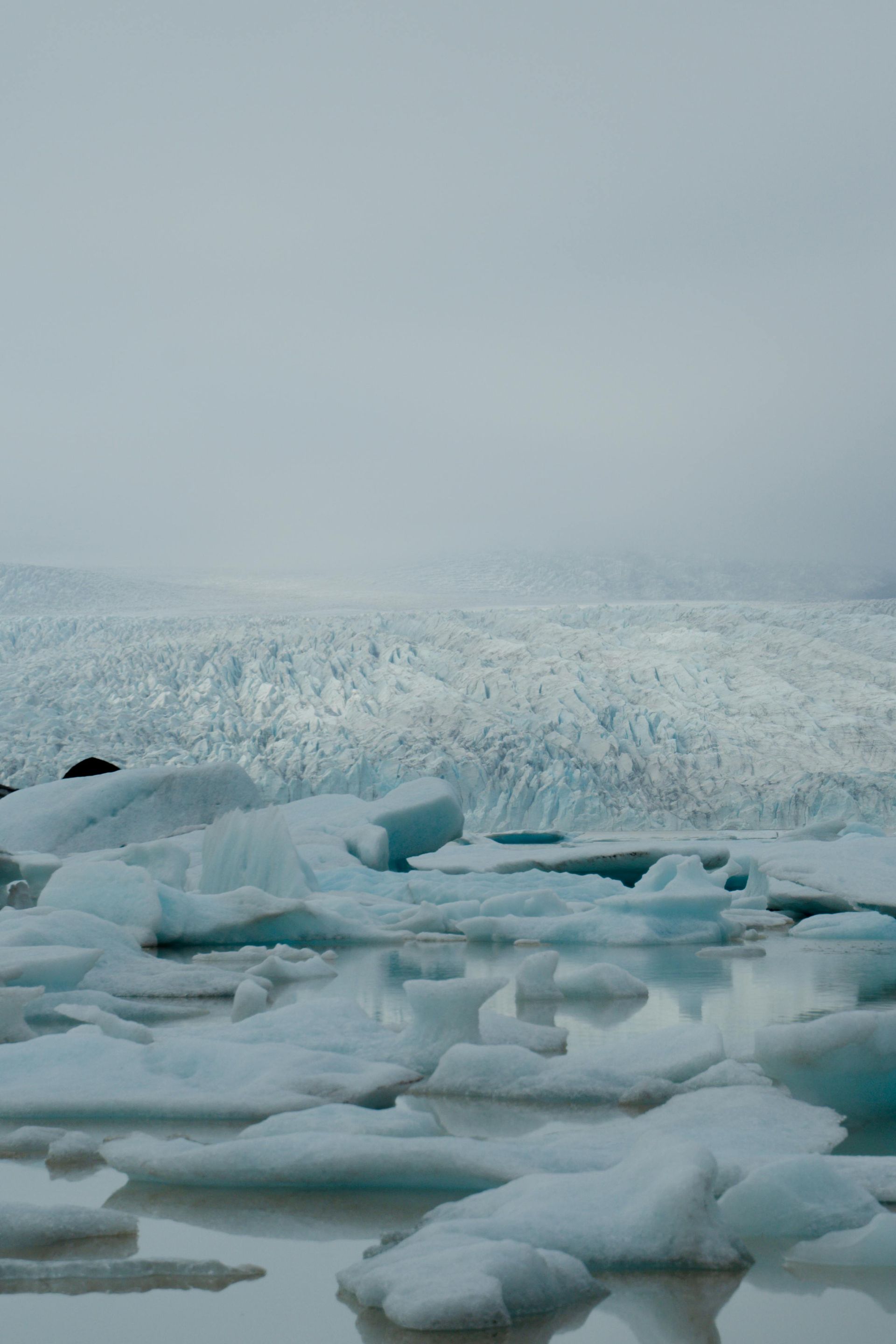
The blue appears because dense glacial ice absorbs all colors of sunlight except blue. Blue wavelengths reflect to your eyes while the rest are absorbed deep within the ice. The purer and denser the ice, the bluer it appears. That brilliant blue color often becomes visible where glaciers crack, calve, or expose freshly compressed ice.
Glaciers are constantly changing:
- They crack, shift, melt, grow, grind rock, and release enormous chunks of ice into the ocean called calving.
- They shape the landscape around them. They carve valleys, create fjords, grind mountains into sediment, and leave behind lakes and glaciers.
- The sediment they leave behind gives these lakes the beautiful milky colors.
Two Types of Glaciers:
- Tidewater Glaciers. - These glaciers flow directly into the ocean. This is where dramatic calving events with giant chunks of ice crashing into the water. These are commonly visited on Alaska cruises, especially in Glacier Bay National Park.
- Land Glaciers. - These glaciers remain on land and are often explored by hiking, helicopter tours, dog sledding excursions, or scenic drives.
Top Five Glaciers to Visit in Alaska
Glacier Bay Glaciers
Location: Southeast Alaska near Gustavus.
Best Way to Visit: Alaska cruise on a small expedition ship.
Why it's special: Glacier Bay National Park is one of Alaska's crown jewels. The park contains multiple massive tidewater glaciers, including Margeries Glacier, Lamplugh Glacier, and Grand Pacific Glacier. Margerie Glacier is particularly famous because it is one of the few glaciers in Alaska that are still actively advancing rather than retreating.
Cruise ships slowly glide through icy waters surrounded by towering snow-covered mountains, while seals rest on floating ice and whales surface nearby. This is one of the best places in Alaska to witness glacier calving.
Best For: First-time Alaska visitors and cruise travelers.
Hubbard Glacier
Location: Near Yakutat in eastern Alaska.
Best Way to Visit: Cruise Ship.
Why It's Special: Hubbard Glacier is absolutely enormous. At roughly 76 miles long and 6 miles wide at its face, it is the largest tidewater glacier in North America. Unlike many glaciers worldwide, Hubbard is actually advancing rather than shrinking. When ships approach Hubbard Glacier, the temperature often drops noticeably. The glacier towers above the water like a frozen blue wall stretching endlessly into the mountains. The calving here can be explosive and dramatic.
Best For: Travelers wanting the most massive glacier experience possible.
Mendenhall Glacier
Location: Juneau, Alaska.
Best Way to Visit: Excursion from the Juneau cruise port or a land tour.
Why it's Special: Mendenhall Glacier is one of Alaska's most accessible glaciers. Located only about 12 miles from downtown Junea, it allows visitors to get remarkably close without needing a helicopter. The visitor center offers incredible panoramic views, educational exhibits, and hiking trails. More adventurous travelers can kayak near the glacier, hike to Nugget Falls, or take guided ice trekking excursions.
Best For: Travelers who want close-up glacier access without requiring extreme adventure.
Exit Glacier
Location: Near Seward, Alaska.
Best Way to Visit: Drive from Seward or take a land tour.
Why it's Special: Exit Glacier is one of the few glaciers in Alaska accessible by road. It is part of the Kenai Fjords National Park and offers visitors the opportunity to walk incredibly close to glacier ice. One of the most powerful aspects of visiting Exit Glacier is seeing markers along the trail showing where the glacier once reached in previous decades. It becomes a visual lesson in climate change and glacial retreat. Visitors can choose between simple walking paths and a guided hardcore ice hike.
Best For: Land travelers and active travelers who want to experience glacier terrain firsthand.
Columbia Glacer
Location: Prince William Sound near Valdez
Best Way to Visit: Boat tour from Valdez.
Why it's Special: Columbia Glacier is one of the fastest-moving glaciers in Alaska. It is famous for producing enormous numbers of icebergs, making Prince William Sound feel almost otherworldly. Boat tours through the sound often include wildlife sightings such as sea otters, puffins, harbor seals, bald eagles, and whales alongside the glacier scenery. The combination of floating blue ice, dramatic mountains, and wildlife creates one of Alaska's most photogenic experiences.
Best For: Travelers seeking both glaciers and incredible marine wildlife.
Are you ready to experience Alaska's Glaciers for Yourself?
After traveling to Alaska multiple times aboard Royal Caribbean, Holland America, Princess, and Norwegian Cruise Lines and experiencing cruises and cruisetours I help my clients choose the Alaska experience that fits them best.
Whether you dream of sailing into Glacier Bay, standing beside Exit Glacier, or witnessing the thunderous calving of Hubbard Glacier, I can help design the perfect Alaska journey for your travel style, comfort level, and bucket list dreams.
Contact me today: carrie.johnson@dreamshaperjourneys.com today to start planning your trip today,